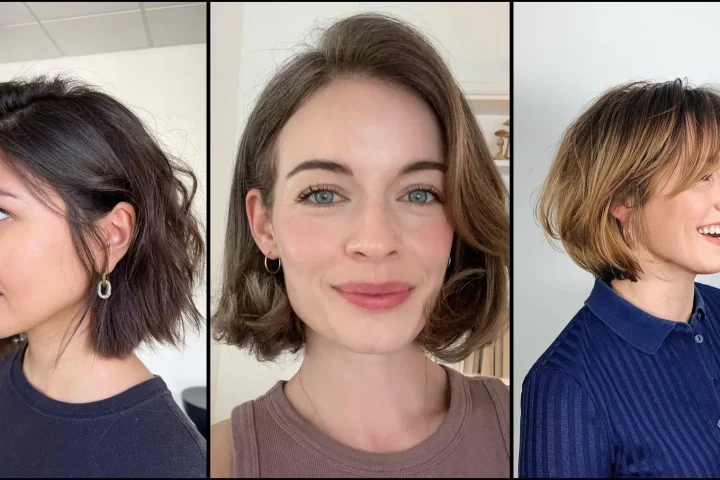
A blunt bob is the sharpest of the bob family. Every strand ends in one clean line, with no layers breaking up the edge, which gives it that precise, deliberate look. It suits people who like hair that looks finished without much fuss: wash it, dry it, and the shape is mostly there. The 21 styles below show how much range sits inside that one idea, from chin-length bobs with a centre part to collarbone bobs with a side part, and from sleek glass hair to soft bends.
Look at the line itself first: check whether the ends sit perfectly even or have a slight bend, and whether the hair is shown smooth or with its natural movement. Straight hair shows the blunt edge at its clearest and makes fine hair look thicker, because nothing is thinned away. Wavy and curly hair can wear a blunt bob too, but the edge reads softer and the shape depends on how the hair is dried, so compare references that match your own texture.
Length changes the whole feel of the cut. Chin length is the sharpest and most striking, jaw length frames the face closely, and a longer bob near the collarbone still ties back. Notice the parting too: a centre part shows the line evenly on both sides, while a side part adds softness where hair is thin. Save the photos that match your hair and routine, not only the ones with the glossiest finish.
Choose the edge and length first
- A jaw-length perimeter puts the outline close to the face. A longer bob leaves more room for tucking, tying and small waves.
- A solid edge can make fine ends look more substantial, but removing too much weight inside the cut may undo that effect.
- Thick or curly hair may need a different internal shape to keep the perimeter from feeling bulky. Compare dry references with similar texture.
Check the everyday finish
Ask how the ends are likely to sit without straightening. A glassy photograph may show a heat-styled finish rather than the natural behavior of the cut. Discuss your part, cowlicks and desired neckline, then ask which areas need reshaping as the edge grows. If your priority is an air-dried bob, say so before choosing an extremely smooth reference.
A blunt edge can look strong in photographs, but the cut still needs to suit your density and routine. Read our fine-hair salon consultation guide for ways to compare weight at the ends before choosing a length.
How to choose your blunt bob
Length is the first choice, and it changes the cut more than any other detail. A chin-length bob is the sharpest version: the line sits right at the face and everything about it looks deliberate. Jaw length is a little softer and frames the face closely. A collarbone bob still ties back and gives you more to work with on days you do not want it down. If your neck is short, a chin-length bob usually sits better than one resting on the shoulders, since the ends can catch and flick. Try the lengths against your own neck and shoulders, not only the model’s face.
Texture decides how clean that line will look. Straight fine hair shows a blunt edge at its best, because the weight stays in the ends and they look thicker. Thick hair can still wear one, but the stylist will usually take weight out from inside the cut, or the perimeter will sit wide and heavy. Wavy hair softens the line and can flip at the ends, so judge it by photos of air-dried hair rather than a smooth blowout. Curly hair cut blunt will spring up and read as a rounded shape, so it should be cut dry, and any fringe should be cut with the curls in mind.
Face shape and upkeep finish the choice. If your face is round, a length that passes the chin and a side part usually suit better than a bob ending at the jaw. If your face is long, width around the cheekbones and a soft fringe help to balance it. A blunt fringe with a blunt bob is the sharpest combination of all, so it suits people who enjoy styling their fringe each morning. A blunt edge shows growth sooner than a layered cut, so plan on a trim every six to eight weeks to keep the line clean, and ask your stylist how the cut will grow out.
Classic Blunt Chin-Length Bob Clean Lines
Ends are cut in one even line right at the chin, with a sleek center part and smooth strands from root to tip. Weight sits at the hem, so this look keeps a sharp, heavy outline.

Sleek Brunette One-Length Jaw-Length Bob
Rich espresso brown is cut to a single length that lands at the jaw, with a crisp edge and an ultra-smooth surface. This look frames the face without any layers breaking the shape.

Warm Wheat Blonde Collarbone Blunt Lob
Warm wheat blonde falls to the collarbone in a blunt line, with subtle face-framing pieces at the front and a silky, straight finish. Finished with a round-brush blowout, this style looks salon-fresh.

Platinum Blonde Sharp Micro Bob Haircut
Very short platinum blonde sits above the jaw with blunt ends and a clean straight part. Every strand of this look lies flat against the face for a graphic outline. The above-jaw length exposes more of the neck and jawline; choose it for the outline you like rather than a face-shape rule. Platinum lightening can be demanding on hair, so ask a colourist to assess its condition and recommend appropriate aftercare before bleaching.

Dimensional Brunette Bob With Curtain Bangs
Lighter and deeper brown tones run through a chin-length cut with clean, blunt ends. Wispy curtain bangs part at the center and frame the eyes, softening the heavy hemline.

Side-Parted Brunette Sleek Blunt Bob
A deep side part sweeps glossy brunette hair over, with a clean straight edge that skims the jawline. On the fuller side, this look falls heavier over the cheek. Round and square faces benefit from the asymmetry, and a little smoothing cream along the part keeps flyaways down.

Espresso Straight Bob Shoulder-Length Clean
Rich espresso hair falls straight to the shoulders in one length, with glossy ends, a centered part, and no layers. This look keeps all its weight at the hem so it swings as one piece.

Short Brunette Balayage Blunt Bob 2026
Chin-length brunette hair is cut to one blunt line, with caramel balayage and loose waves running through the lengths. Tousled bends add movement to the surface, but this look keeps an even, heavy hem at the front and back.

Blunt Cut Chin Bob Dark Straight Hair
Laser-straight, deep dark brown hair is cut to skim the chin in one uniform line, with a clean center part. This look keeps a graphic, structured outline without layers. Thick, straight hair holds the edge best, and a flat iron run once over the ends keeps the line crisp.

Soft Ash Blonde Wispy Fringe Bob Haircut
Ash blonde hair is cut bluntly just below the chin, with wispy bangs brushing the brows. This look has a silky finish with slight face-framing movement at the front.

Platinum Bob Middle Part Thin Hair
Center-parted platinum blonde sits at chin level, with mirror-smooth strands and a dense blunt edge. That even hem makes this style looks thicker at the ends. Fine hair benefits from the weight kept at the perimeter, and a bond-repair mask weekly protects the lightened strands.

Modern Blunt Bob Fine Hair Straight Brunette
Fine, straight brunette hair is cut to chin length with zero layers and a clean line across the bottom. This look keeps a smooth, glossy surface and full-looking ends. Ask for the length to stop at the chin rather than lower, and a volumizing spray at the roots adds lift.

Classy Medium Blonde Blunt Lob Straight
Blonde hair with subtle highlights falls straight to the collarbone and ends in a sharp blunt edge. Golden and beige tones blend across the silky surface of this look.

Classic Chin-Length Bob With Side Bangs
Side-swept bangs fall across the forehead in wispy pieces, while the chin-length cut keeps a clean blunt edge. Smoothed straight, this look stays sleek around the face.

Short Dark Bob Sharp Blunt Edge Women
Deep dark brown is cut short with a clean, straight edge right at the jawline. This look has silky strands and a precise, graphic finish. Thick, straight hair holds the sharp edge best, and a trim every five to six weeks keeps the line exact.

Honey Blonde Wavy Blunt Bob Voluminous
Warm honey blonde falls to the shoulders with blunt ends and loose, tousled waves. Volume builds through the mid-lengths of this look for a beachy finish. Medium to thick hair holds the waves, and a one-inch curling wand with sea salt spray adds the bend.

Sleek Black One-Length Bob No Bangs
Glossy jet black falls in one length with a clean straight edge at the jaw and a center part. This look keeps the forehead open and the outline symmetrical.

Brunette Bob Money Piece Highlights Warm
Money-piece highlights brighten the strands around the face on a chin-length brunette cut with clean blunt ends. This look finishes in a warm bronde shade.

Soft Balayage Bob Chin Length Fine Straight
Warm brunette roots melt into golden blonde ends through a chin-length blunt cut with a smooth, straight surface. With its clean edge, this look makes fine hair look denser.

Short Blonde Bob Curtain Bangs Middle Part
Curtain bangs part at the center, with feathered tips grazing the brows, on a short blonde cut with an even edge at the chin. This look frames the eyes and cheekbones.

Chestnut Brown Bob Above Shoulders Polished
Chestnut brown is cut bluntly just above the shoulders, with a subtle side part and smooth strands. This look has a warm, glossy finish and clean ends.

For a different bob outline, compare Italian bob haircuts for rounded fullness and French bob haircuts for shorter lengths and fringe options.
Styling and upkeep
A blunt bob asks for little styling, but it asks for neatness. Blow-dry with the nozzle pointing down and a round brush under the ends, and the line will sit evenly. If you want the mirror-smooth finish, a flat iron through the lengths and a small amount of smoothing serum will do it, but keep product off the roots so the hair does not look flat. For a bend instead of a poker-straight finish, curl the mid-lengths with a flat iron and leave the last inch straight, which keeps the edge looking blunt while the rest of the hair moves.
The line is what you are maintaining, so the trim schedule matters more than with a layered cut. About every six to eight weeks keeps the edge clean; leave it longer and the outline starts to look ragged, especially at the back where you cannot see it. Use a heat protectant every time you iron, and go easy on heavy oils near the ends, since they make fine hair stringy. On mornings when the ends have flipped in the night, a brush and a short pass with the dryer are usually enough, rather than restyling from wet.
Frequently asked questions
Will a blunt bob make my hair look thicker?
For fine, straight hair, usually yes. The ends stay at full weight instead of being thinned away, so the line looks dense. Thick hair can look heavier rather than thicker, so your stylist may take weight out from inside the cut while keeping the edge clean.
Does a blunt bob suit curly or wavy hair?
It can, but the result is different from the straight version. The edge reads softer and the shape becomes more rounded as the curls spring up, so the cut should be done dry or checked dry. Wavy hair usually needs a little extra length so the ends do not flip more than you want.
How do I keep the ends looking sharp between cuts?
Dry them with a round brush or a flat iron and always use a heat protectant. Turn the ends under for a neat finish, and resist curling right to the tips, since that softens the line. A trim every six to eight weeks is what keeps the edge from going ragged.
Can I wear a blunt bob with a fringe?
Yes, and the combination is the sharpest look in this collection. A blunt fringe needs styling most mornings, so it suits people who enjoy that routine. A curtain or side fringe softens the whole cut and is easier to grow out if you change your mind.
What is the difference between a blunt bob and a layered bob?
A blunt bob ends in one even line with no layers inside, which makes the ends look thicker and the shape more precise. A layered bob has shorter pieces inside that add movement and lighten the ends. The blunt version shows growth sooner, so it needs trims a little more often.
Choosing a blunt bob is mostly about the line: how sharp you want it, where you want it to sit, and how much upkeep you are willing to give it. Save two or three photos that match your texture and your parting, including a side view so your stylist can see how the edge sits at the back. Talk through the length dry, the fringe if there is one, and how you usually style your hair in the morning. If the cut still looks clean a few weeks later without a daily battle with the iron, you have found the right version of it.