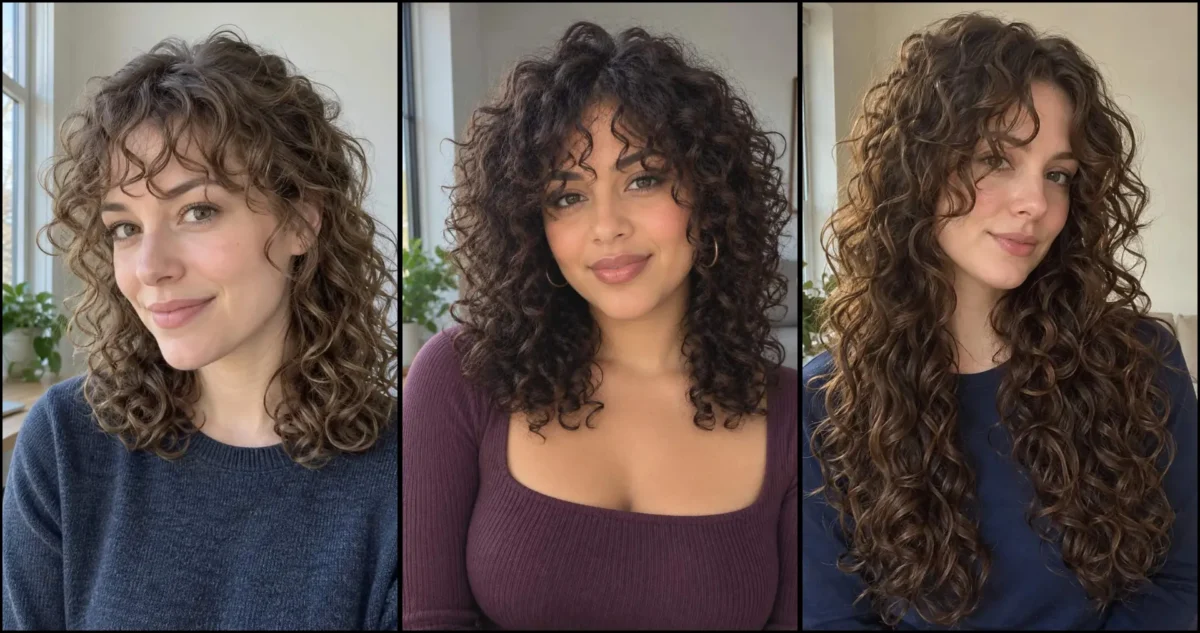
Curly bangs bring springy texture to the forehead, changing a haircut’s shape without flattening the natural curl pattern. They can feel airy, full, rounded, or directional depending on length, density, and parting.
Rounded curly fringe for natural curls
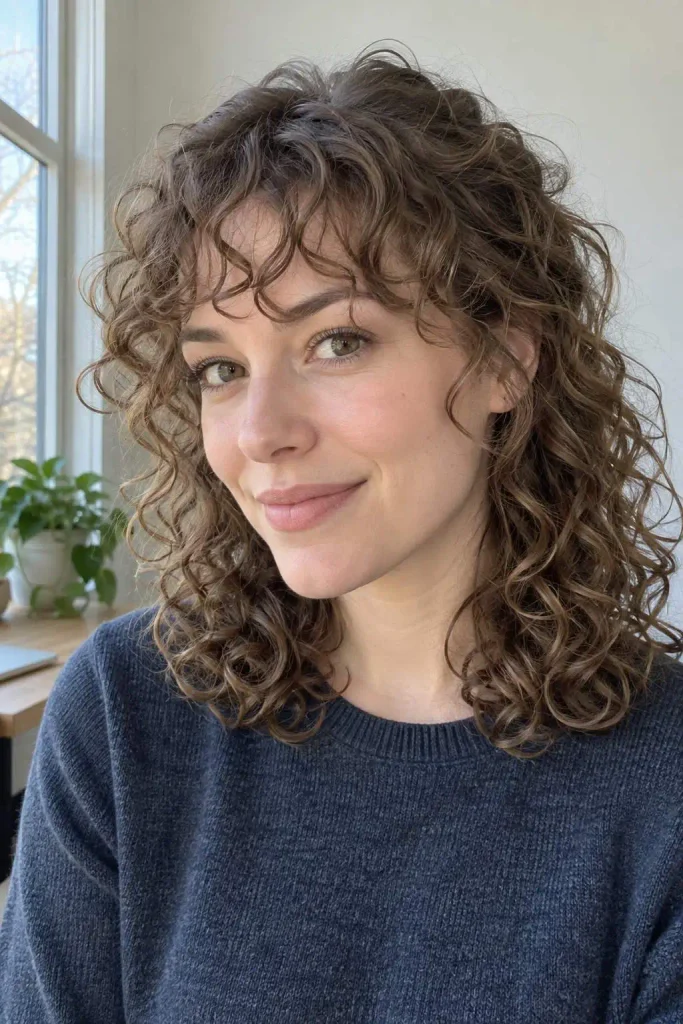
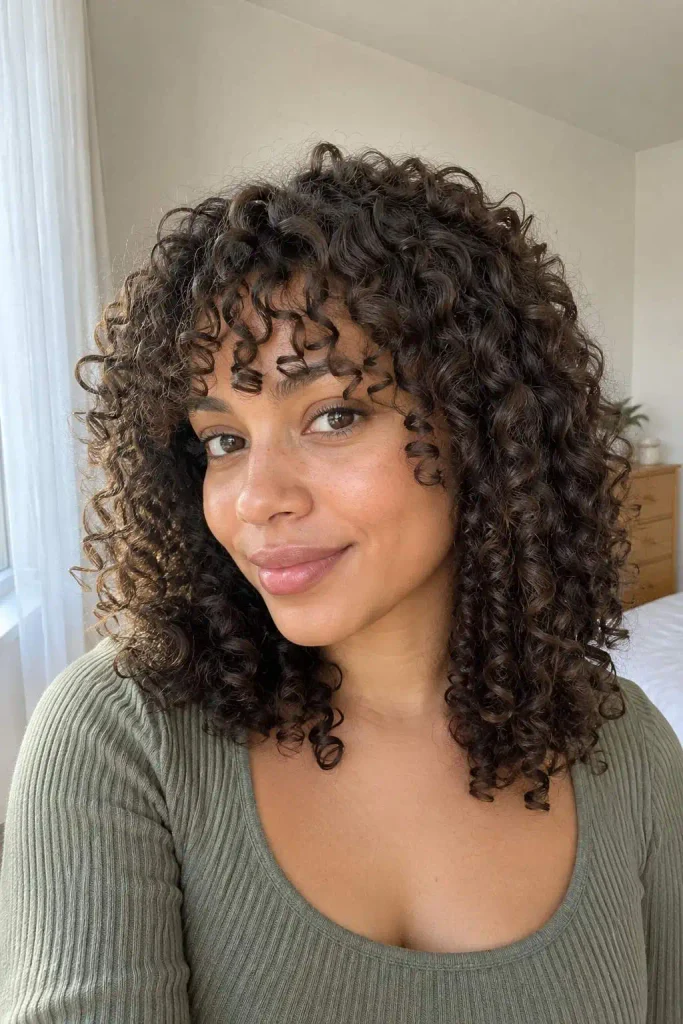
Clustered curls follow the arc of the forehead, cut slightly shorter through the center and longer toward the temples. Dark chocolate brown color shows each coil against the skin. Medium to dense curls carry a rounded curly fringe for natural curls best, since the front stays full and blends into the side layers without a hard straight line.
Long curly curtain bangs
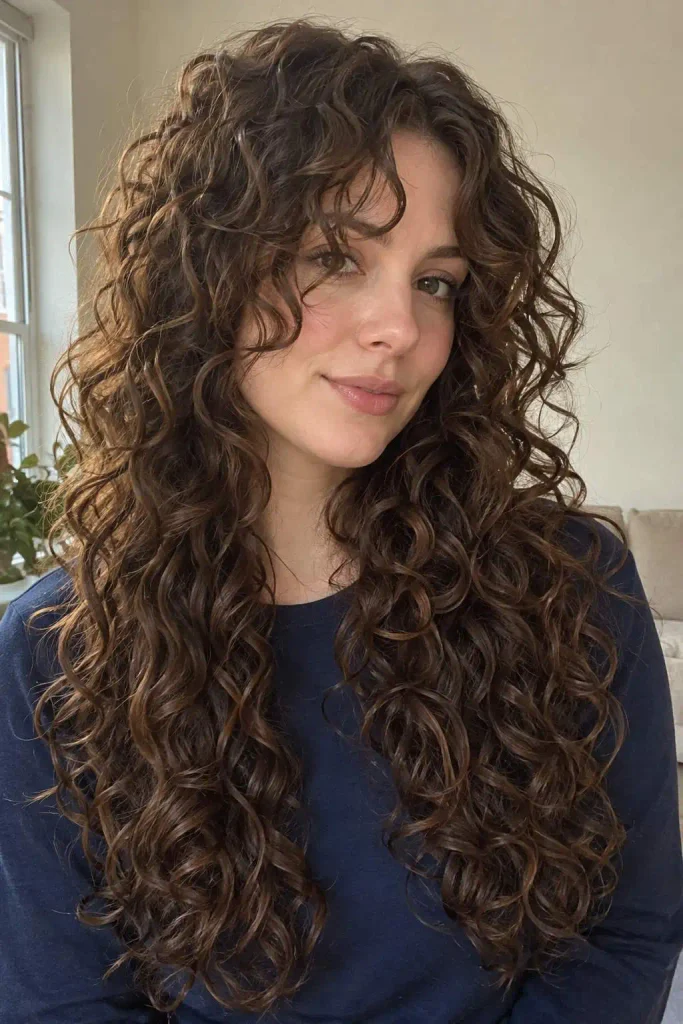
Split near the center, the fringe falls toward the cheekbones in loose spirals that connect with longer layers. Slightly shorter middle pieces open the front around the eyes. Shoulder-length or long curly hair in warm caramel brown suits long curly curtain bangs, and diffusing them with the head tilted forward helps the curtain shape split cleanly, especially on 3A and 3B curls.
Soft side-swept curly bangs
From a clear side part, curls move diagonally across the forehead, with the shortest ones near the brow and longer pieces falling toward one temple. Here the shade is a rich auburn. Medium cuts, bobs, and layered curls pair well with soft side-swept curly bangs, and clipping the fringe sideways while it dries locks in the direction.
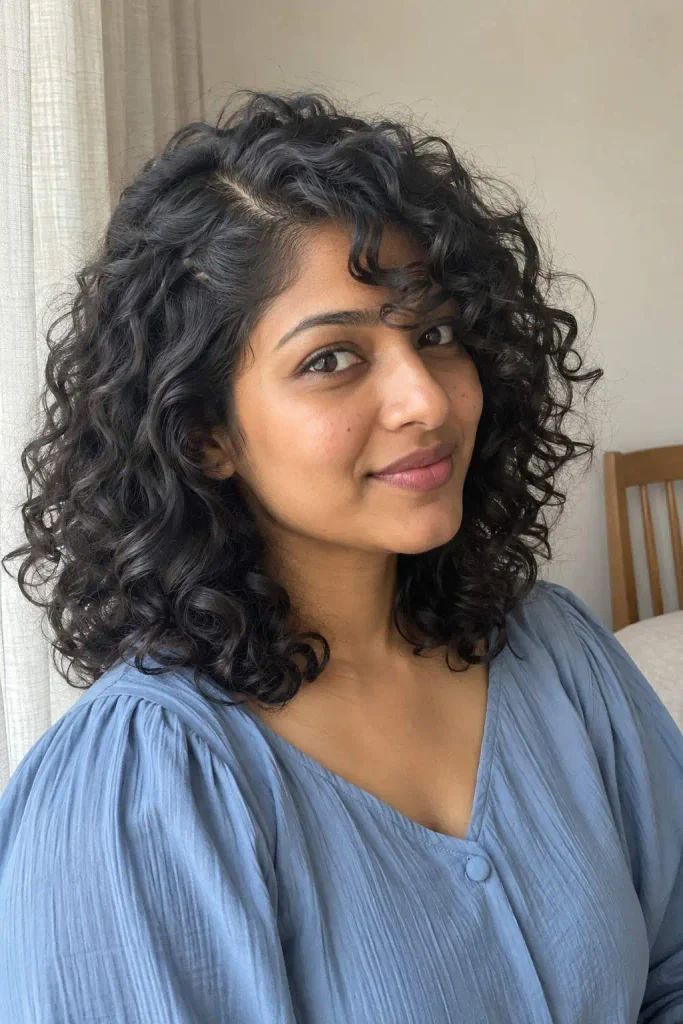
Short curly baby bangs
Small, defined curl groups sit well above the brows, leaving more forehead visible while the front stays connected to the rest of the hair. Jet black color makes the short length graphic. Cutting each curl individually is the secret to short curly baby bangs, and a stylist should trim them dry so shrinkage does not pull them shorter than planned.
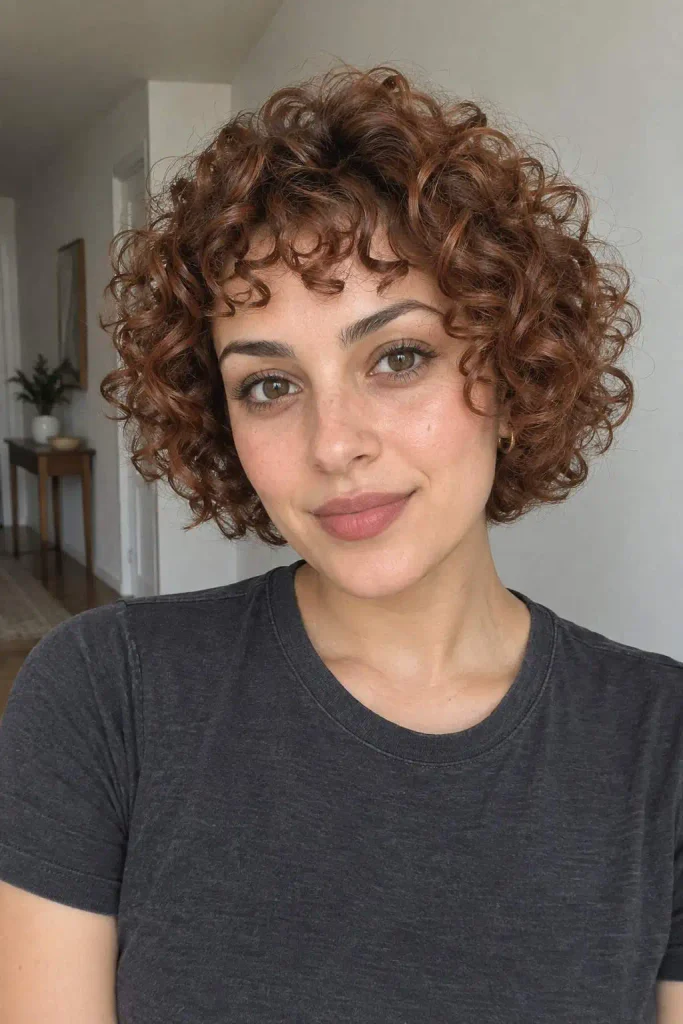
Wispy curly bangs with layers
Only a small amount of hair is used at the front, so separated curls show visible space between them instead of a dense fringe. Light honey brown layers keep the cut airy around the face. Fine to medium density hair suits wispy curly bangs with layers, and a lightweight mousse adds definition without weighing the thin front curls down.
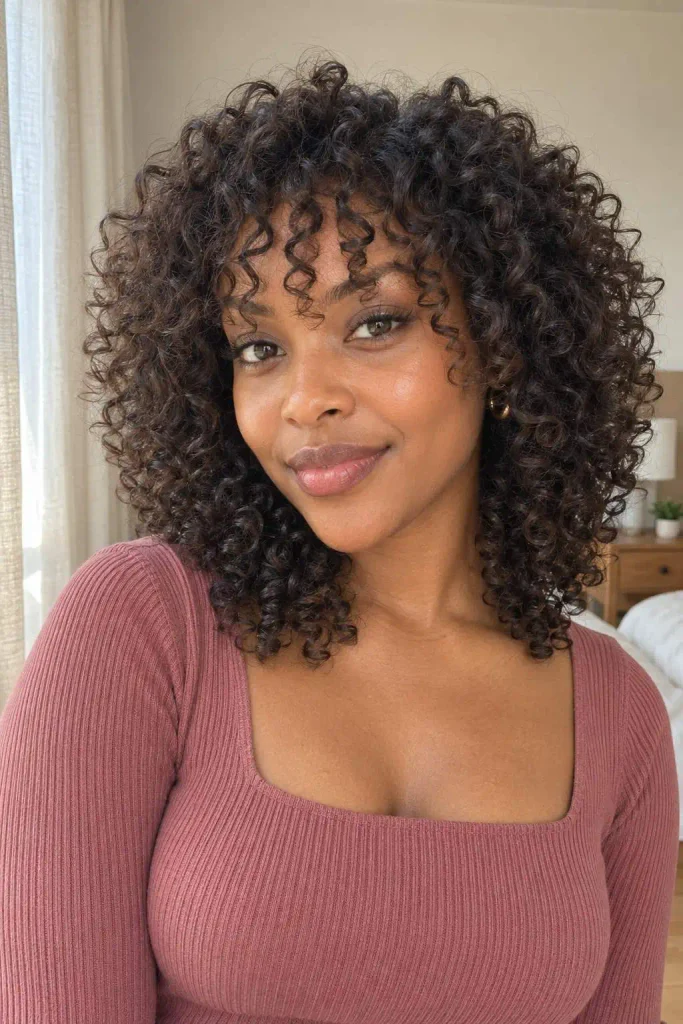
Full curly fringe with volume
Several curl clusters create density across the forehead, giving the front a clearly defined shape that matches wide, rounded sides. Deep espresso color adds depth to the volume. For thick curls and rounded cuts, a full curly fringe with volume keeps the front from looking sparse, and lifting the roots with a pick after diffusing adds height.
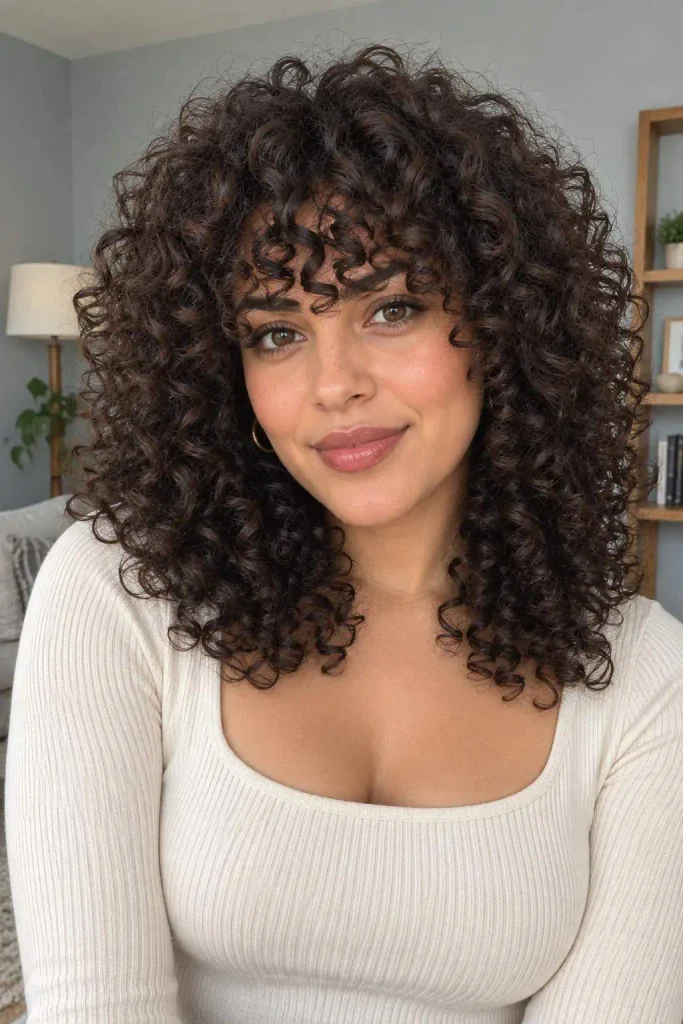
Long center-parted curly bangs
Curls fall on both sides of the forehead with an opening through the middle, their ends reaching toward the cheekbones. Light chestnut brown shows the spiral pattern clearly. With long center-parted curly bangs, there is enough length to tuck, pin, or sweep the fringe away on busy days, and a center part set while wet keeps the split even, even after a full day of wear.
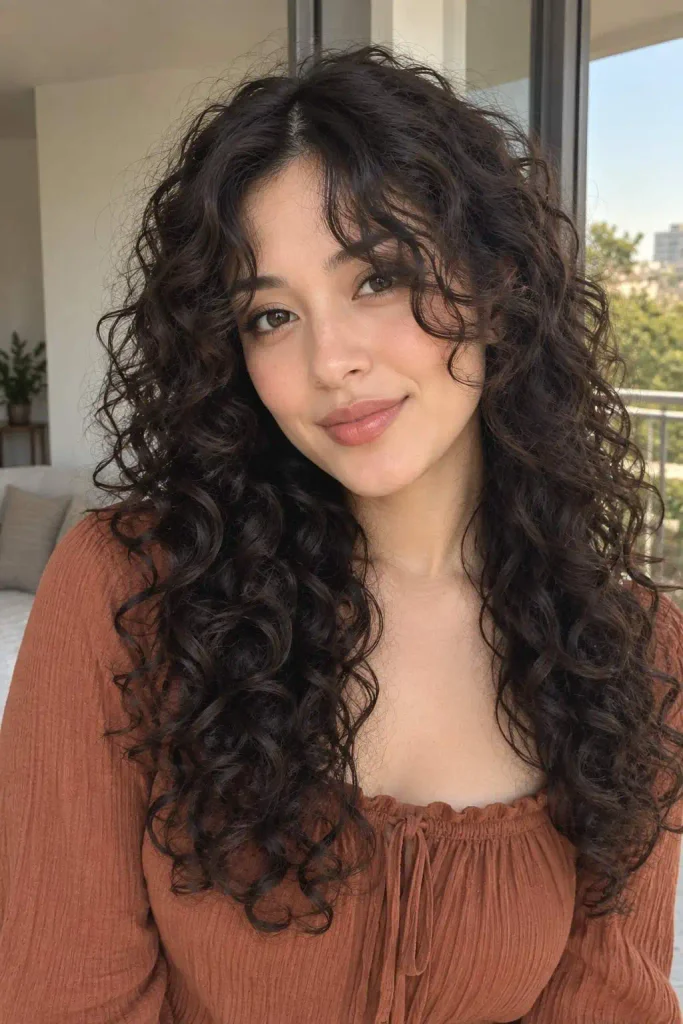
Asymmetric curly fringe with side part
One side sits visibly shorter, while longer curls sweep across the forehead from a deep side part. That uneven length gives the front clear direction. A simple bob or medium cut in dark ash brown gains movement from an asymmetric curly fringe with side part, and asking for the cut on dry curls keeps the angle accurate.
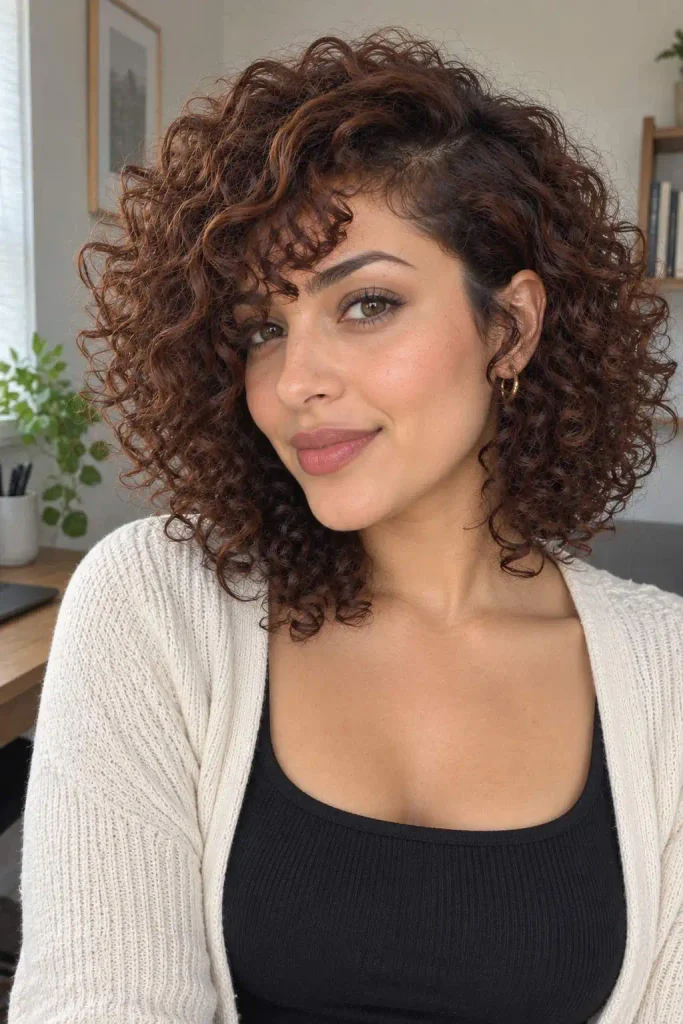
Curly bob with arched bangs
Chin-length curls frame a rounded fringe that sits shorter near the center and lengthens gradually toward the outer corners. Warm medium brown color shows the arch clearly. A curly bob with arched bangs echoes the curved perimeter of the cut, and oval or heart-shaped faces benefit most from the way it frames the eyes and cheekbones.
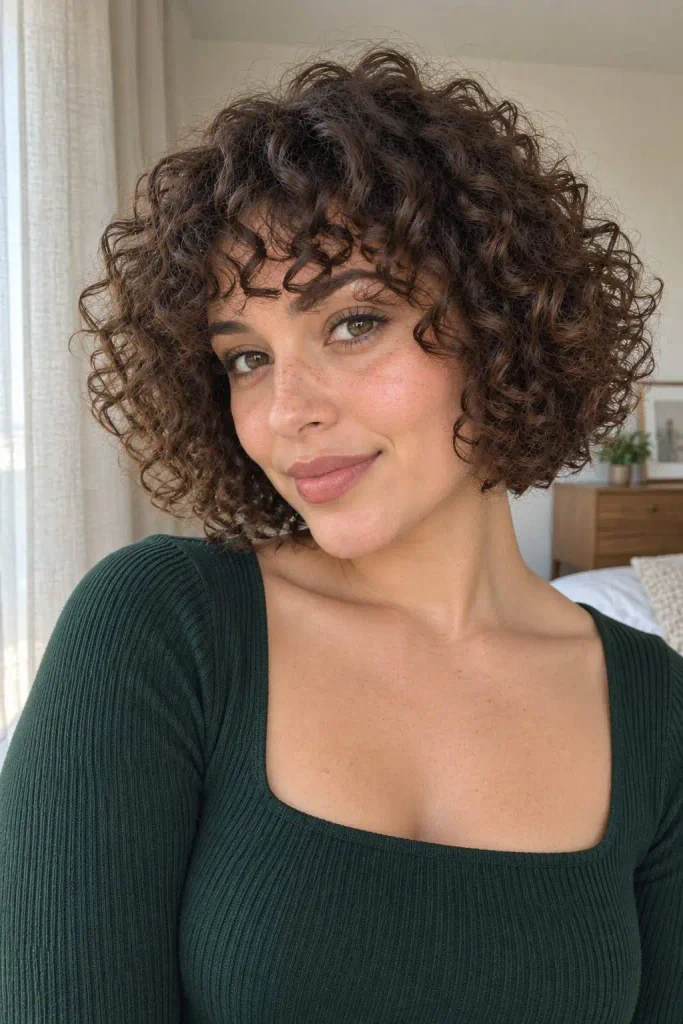
Curly shag with feathered fringe
Short crown layers and broken-up lengths meet a light fringe that separates into airy curl pieces across the forehead. Copper red color highlights each layer and the broken ends. Medium or long curly hair suits a curly shag with feathered fringe, and scrunching a curl cream into wet hair before diffusing on low heat builds lift at the crown, while the ends stay piecey.
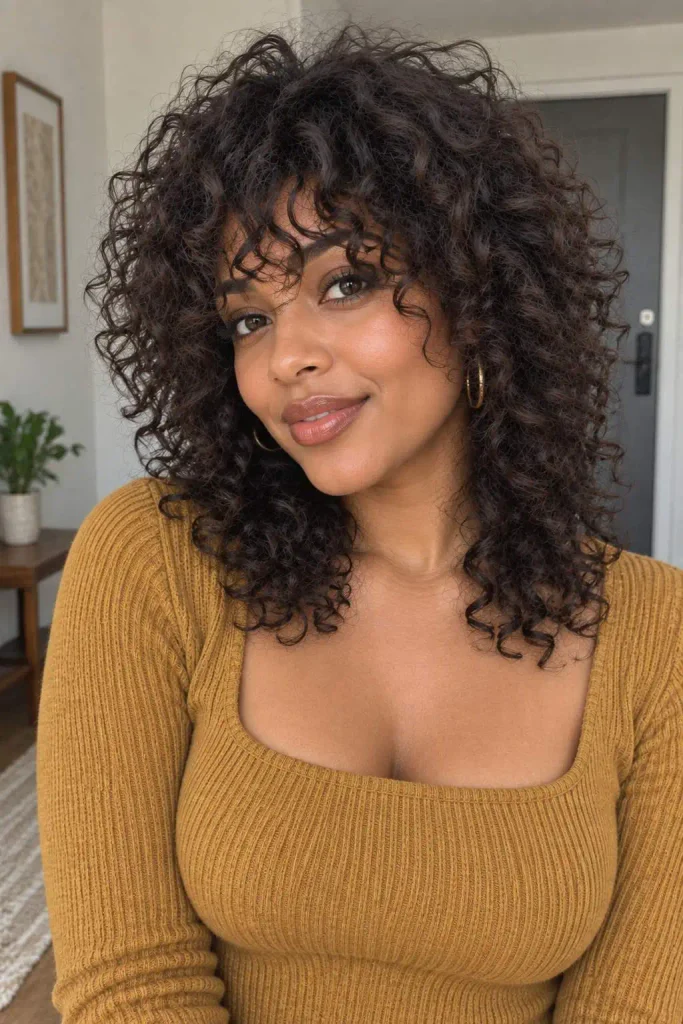
Layered curly bangs with face framing
Shorter front curls connect to cheekbone and jaw-length pieces, forming a gradual transition instead of a separate block at the forehead. Honey blonde balayage on a light brown base brightens the frame. On medium and long hair, layered curly bangs with face framing keep the silhouette continuous, and trims every eight to ten weeks keep the steps blended.
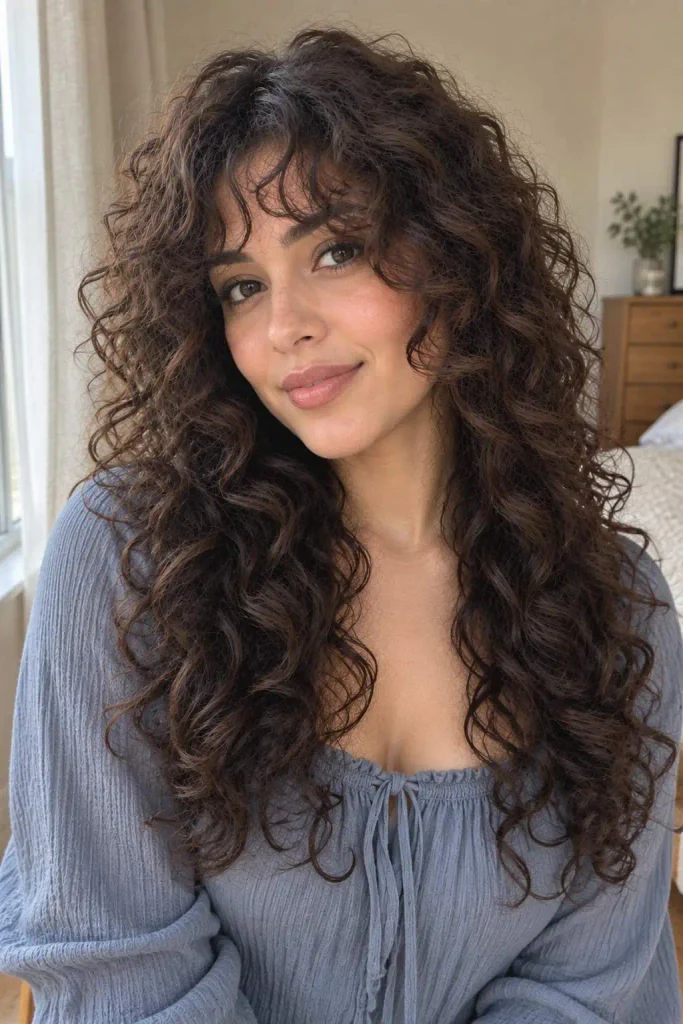
Curly bangs for round faces
A slightly open center, uneven curl lengths, and longer pieces at the temples keep the width away from cheek level. Small areas of forehead show through. Connected to vertical face-framing layers, curly bangs for round faces create a longer visual line, and in dark brown hair those vertical pieces read clearly from the front and in three-quarter view.
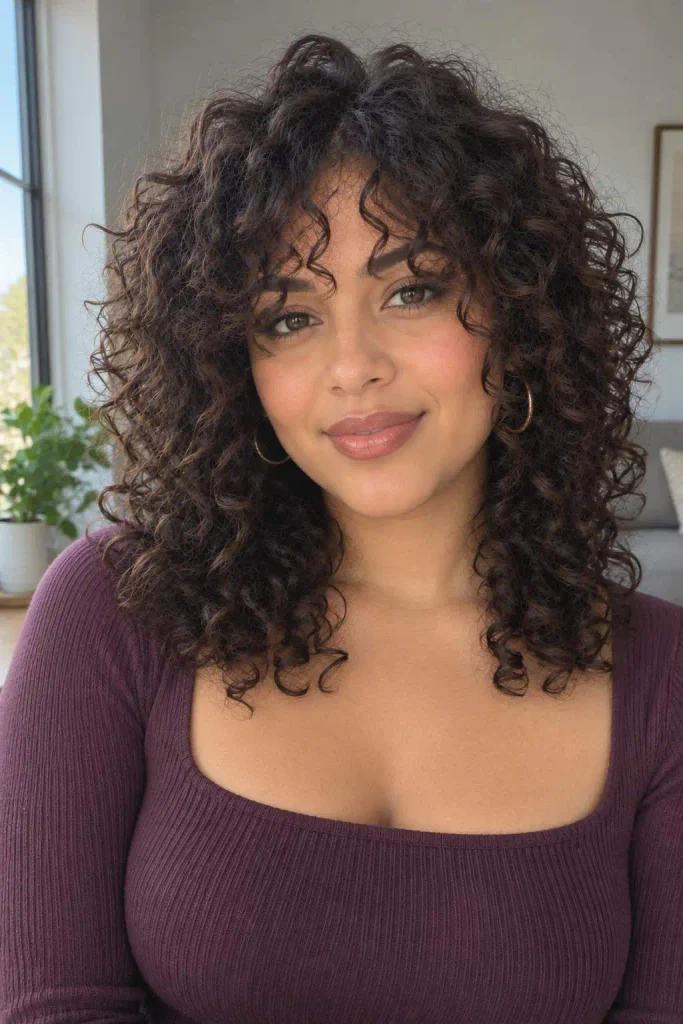
Curly bangs for oval faces
Brow-length spirals or a fuller rounded fringe both work here, because balanced proportions handle many front shapes. Medium-density curls in golden brown sit right at the brows. Flexibility is the main appeal of curly bangs for oval faces, which can shift between more openness, more volume, or a center part, so asking for a slightly longer first cut leaves room to experiment before committing to a shorter fringe.
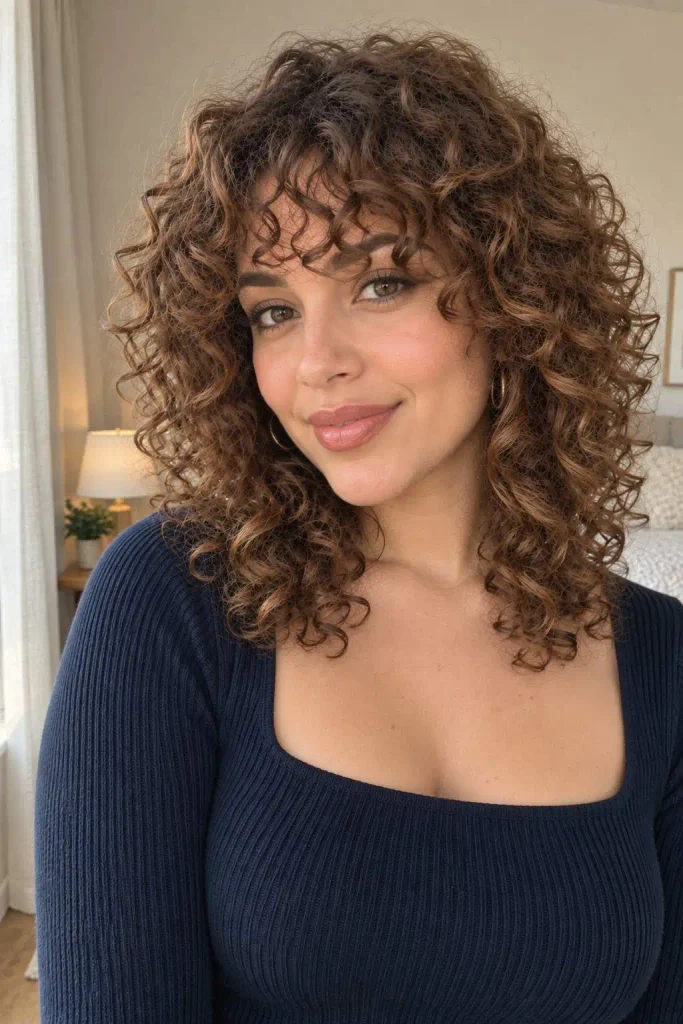
Long curly fringe with shoulder-length hair
Bangs reach toward the brows and upper cheeks, blending into shoulder-length curls with very little separation from the layers. Mocha brown color keeps the transition seamless from every angle. For anyone wanting face framing without a short commitment, a long curly fringe with shoulder-length hair is a practical start, and it grows out without an awkward stage.
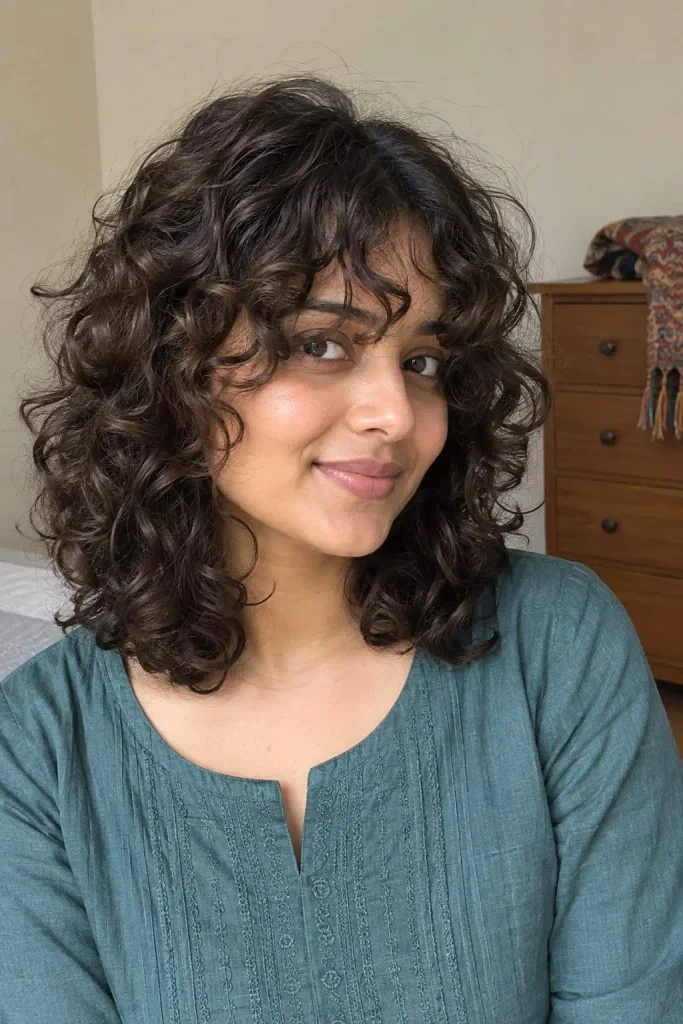
Thick curly bangs on natural hair
A wide, dense front section gives the fringe enough weight to match a full, rounded shape of coily hair. Ends are shaped at slightly different heights. High-volume curl patterns in jet black suit thick curly bangs on natural hair, and a shingling method with a leave-in and gel keeps the front from becoming one heavy wall.
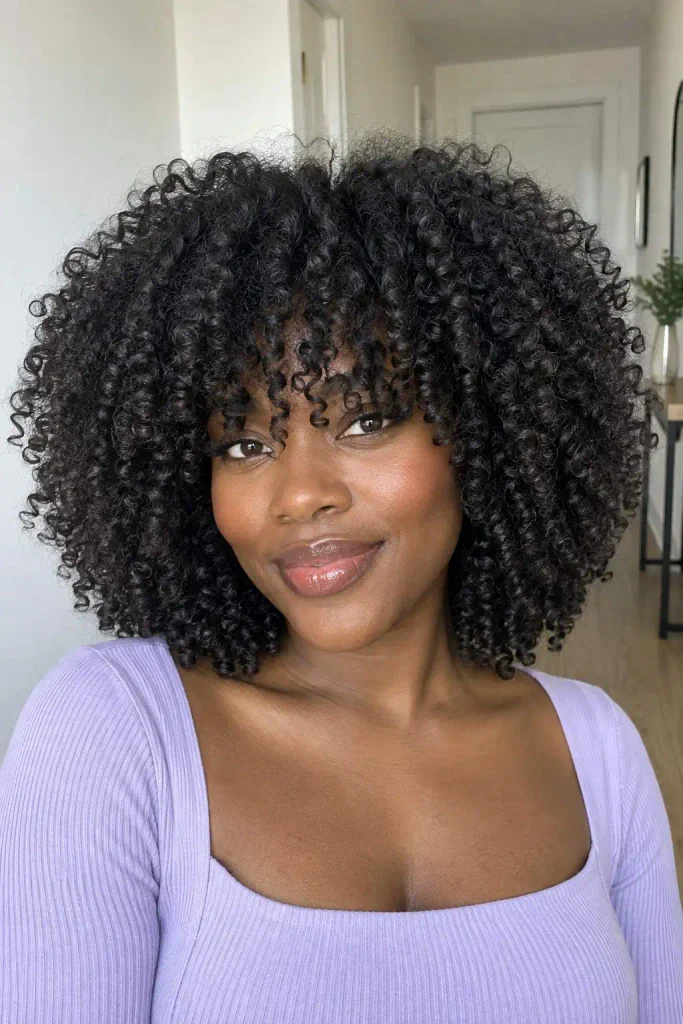
Curly bangs for 3B and 3C curls
Springy ringlets are shaped curl by curl, so each one settles at a slightly different length across the forehead. Layered side pieces blend the tighter curls into the cut. Curly bangs for 3B and 3C curls need room for shrinkage, so they should be cut longer than the target length, and dark brown color shows the ringlets well.
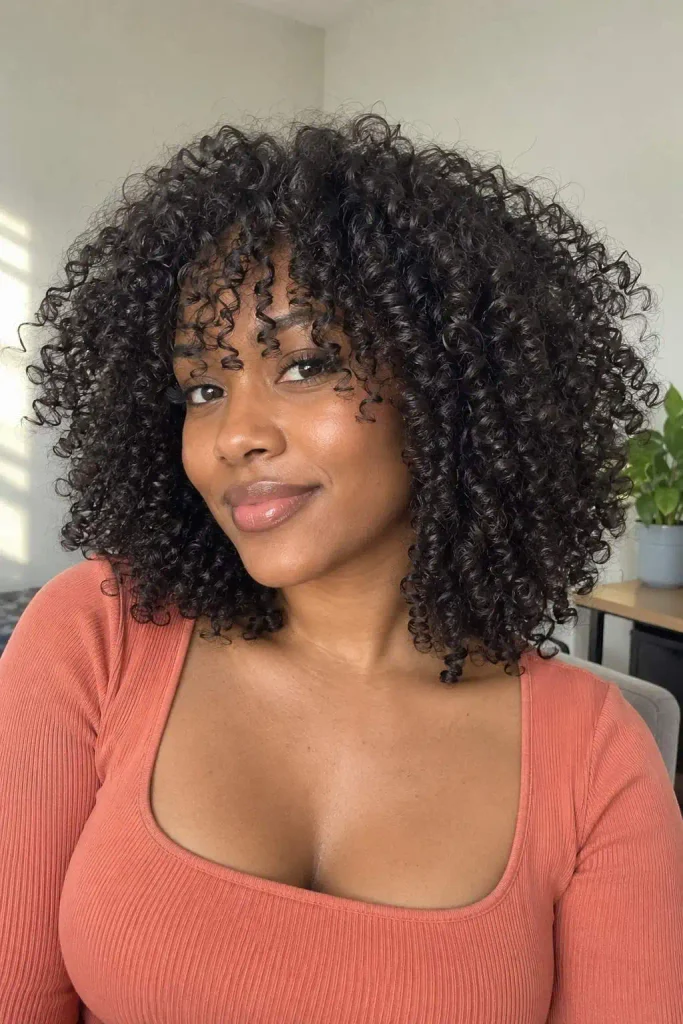
Coily curly bangs for Black women
Defined, springy coils form a rounded front with airy separation and enough density to connect with the volume behind. Jet black coils frame the face evenly. Coily curly bangs for Black women work with an afro, a tapered shape, or a layered cut, and a curl-by-curl cut on stretched-dry hair gives the most predictable result.
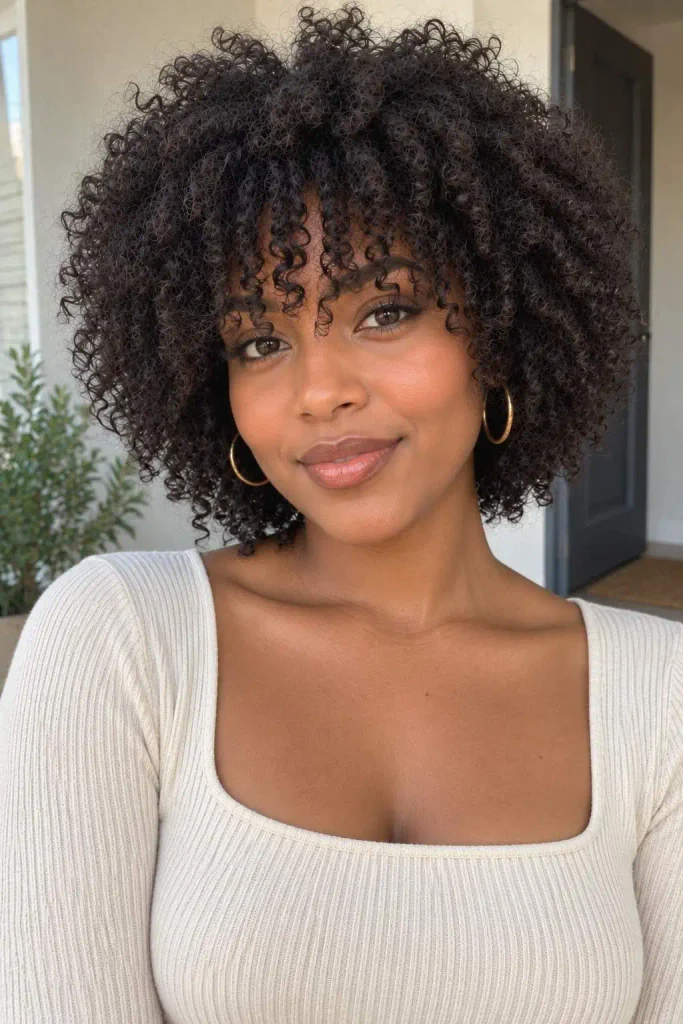
Curly wolf cut with curtain bangs
Short, lifted crown layers sit above longer choppy lengths, with a center-opening fringe that moves away from the eyes. Dark honey brown shows the separation through the top. A curly wolf cut with curtain bangs differs from a classic long shag in its height, and diffusing upside down plus a root-lift spray keeps the crown full.
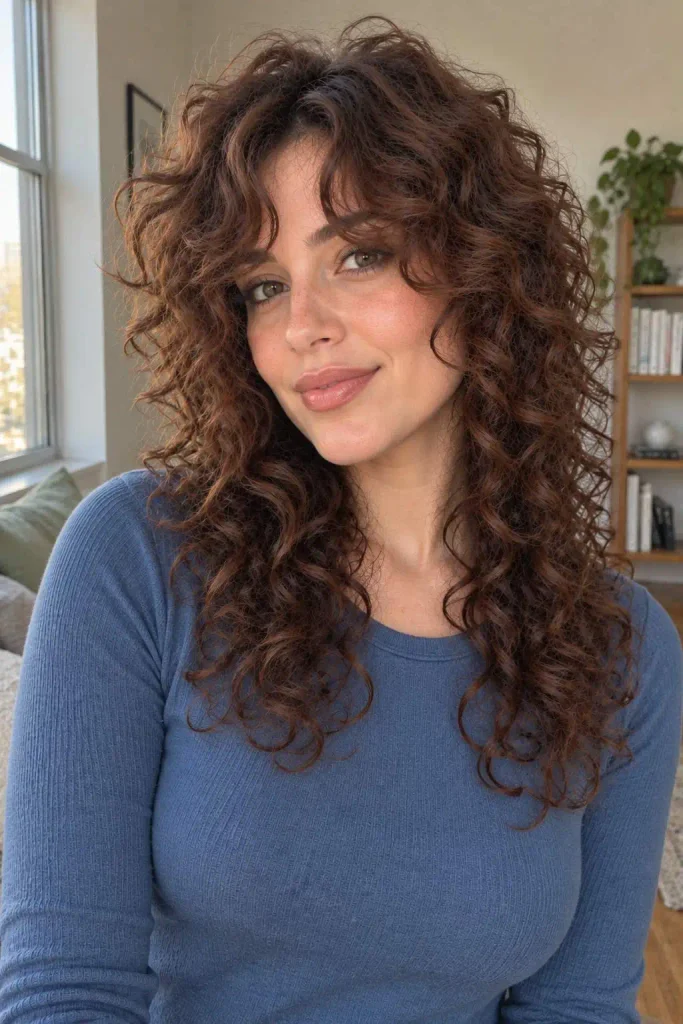
Short curly wolf cut bangs
Bangs land above or around the brows and connect quickly into choppy crown layers, creating a compact shape. Fringe, sides, and top share a broken-up rhythm. Short to medium curls in a cool ash brown suit short curly wolf cut bangs, and refreshing the front with water and a dab of curl cream revives them between washes and on the second or third day after styling.
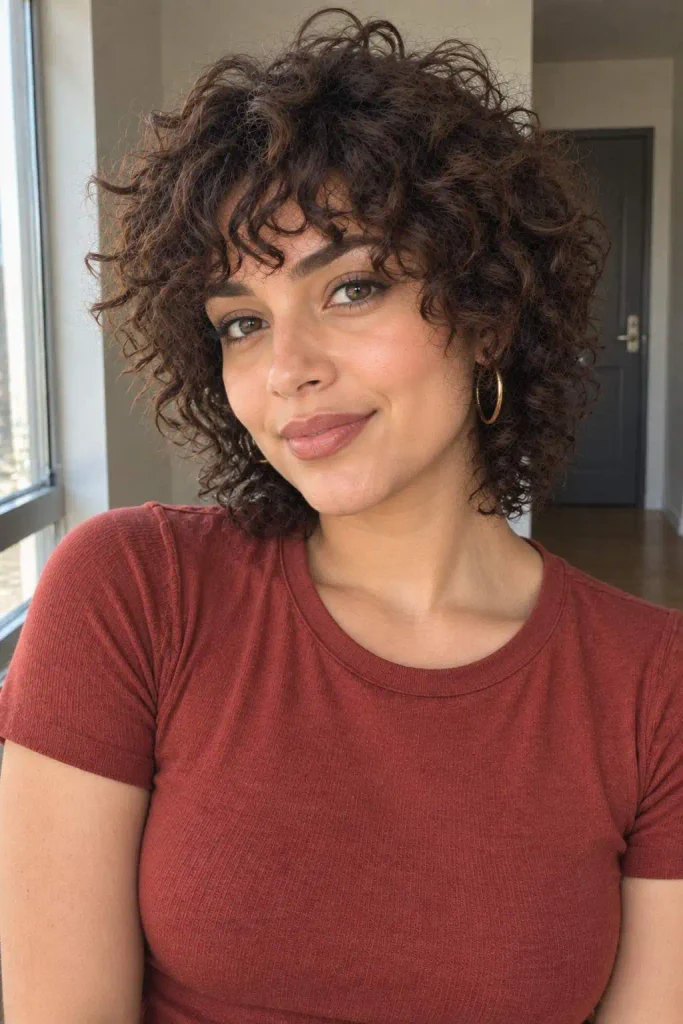
Curly pixie with spiral bangs
Cropped sides and back contrast with a longer front, where a few defined curls fall across the forehead. Platinum blonde color makes each spiral stand out. A curly pixie with spiral bangs keeps the ears and jawline visible, and trims every four to six weeks hold the short perimeter while the front curls grow slightly longer.
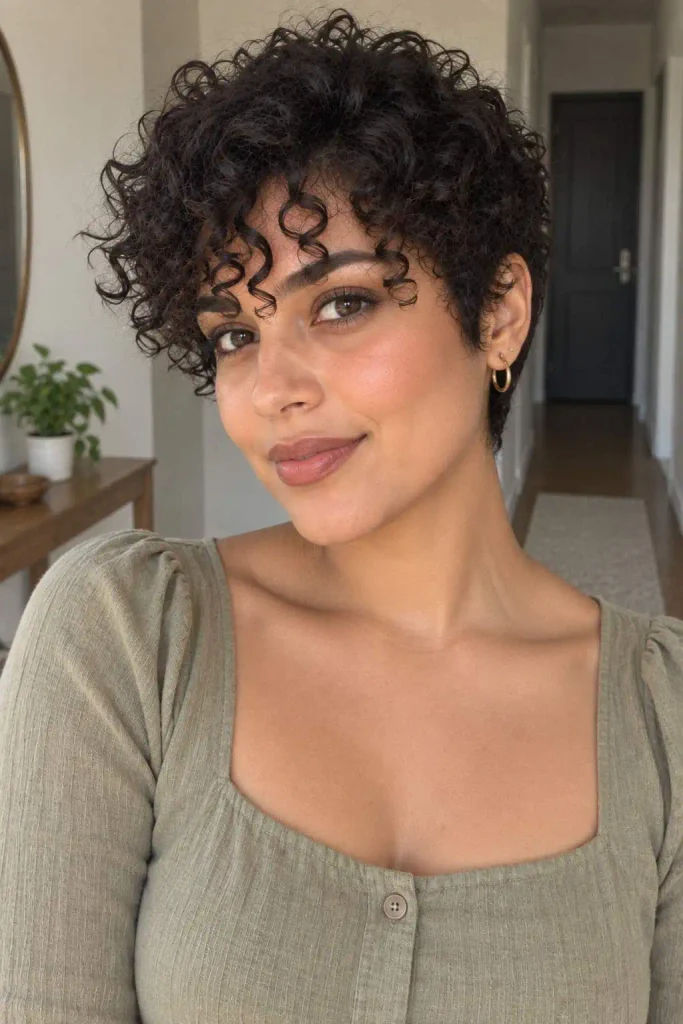
Defined finger-coiled curly bangs
Front spirals are separated and shaped one curl at a time, creating a neat pattern that never looks stiff. Deep brown coils sit right at brow length, evenly spaced. To create defined finger-coiled curly bangs, wrap each gelled section around a finger on soaking-wet hair, then air-drying or a hooded dryer so the coils set without frizz at the hairline.
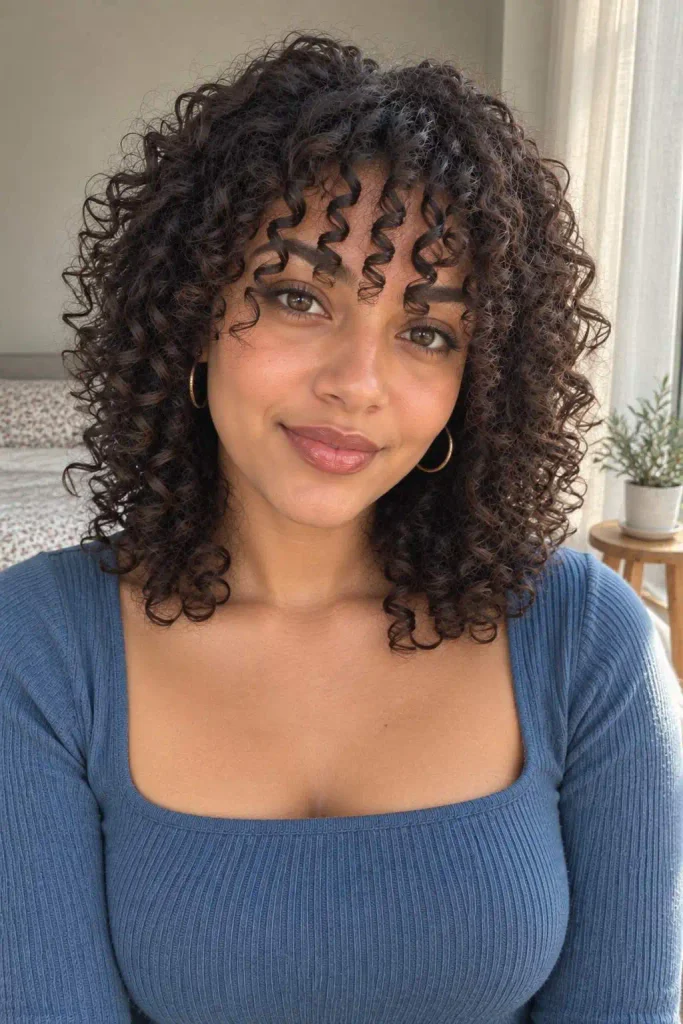
Curly updo with soft bangs
Most of the hair is pulled up and away from the face, leaving a light fringe and a few controlled curls around the temples. Rich chestnut color shows the contrast between the gathered crown and loose front. A curly updo with soft bangs suits casual or dressier days, and a large claw clip secures the length at the back without crushing the curls.
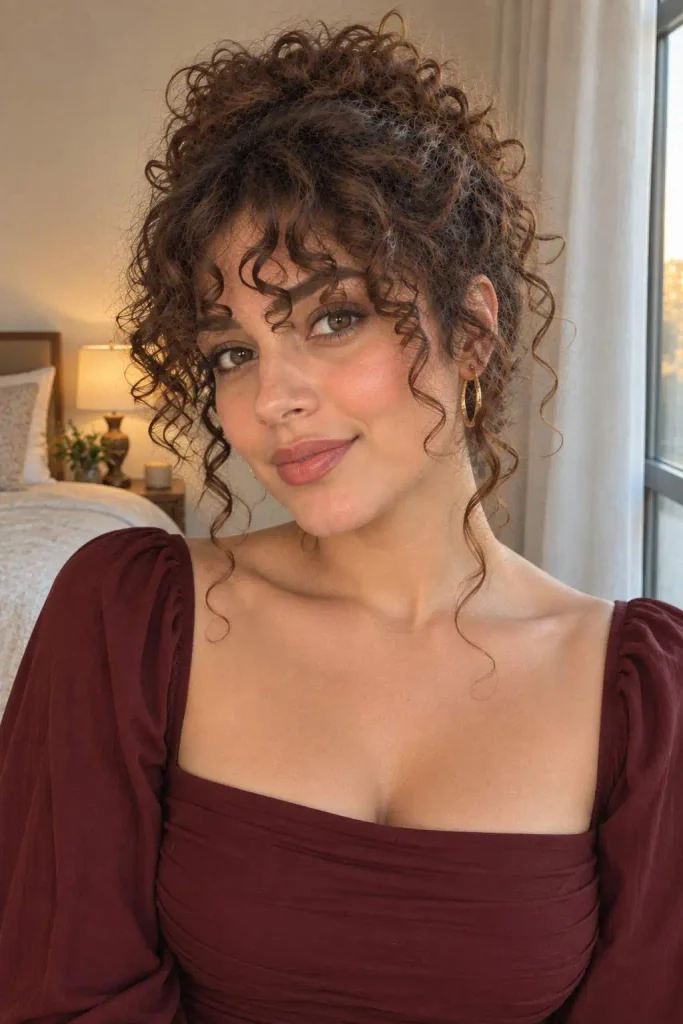
Curly ponytail with loose bangs
Main length is gathered into a mid or high ponytail at the back, while curls stay free across the forehead and around the temples. Lift behind the fringe frames it clearly. Everyday wear suits a curly ponytail with loose bangs, and a silk scrunchie placed loosely on dark brown curls avoids flattening the pattern near the base.
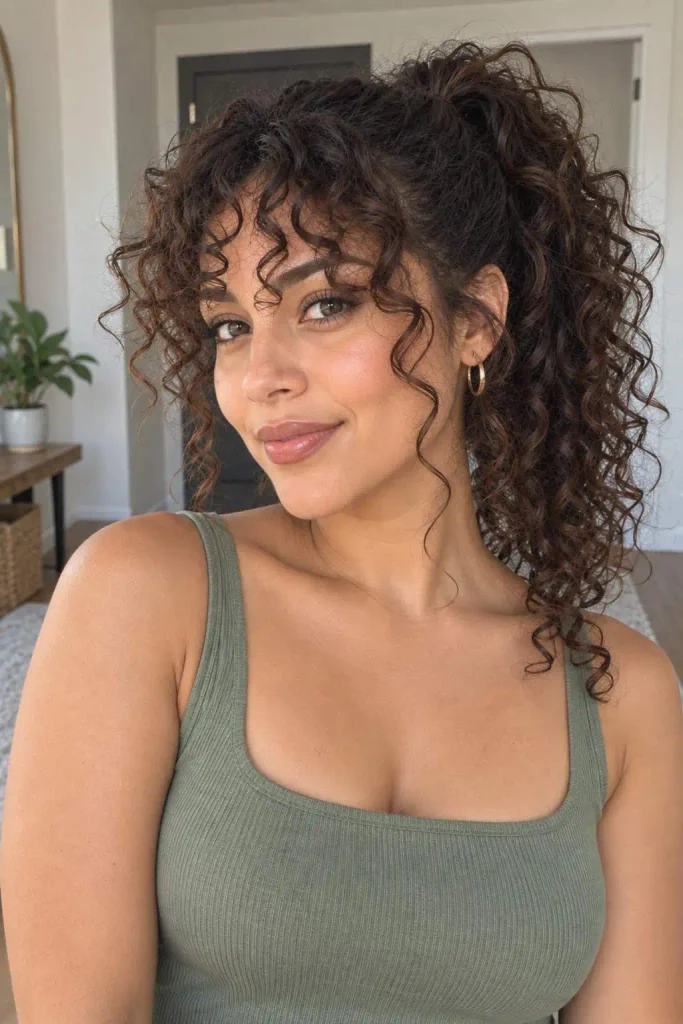
Curly sew-in with full bangs
A dense front fringe matches the curl pattern and volume of the installed lengths, creating a continuous shape from forehead to sides. Off-black 1B hair blends with the leave-out. For rounded, shoulder-length, or long shapes, a curly sew-in with full bangs looks seamless when the fringe hits brow level, and spraying the curls with water and leave-in revives them when they start to loosen around day three.
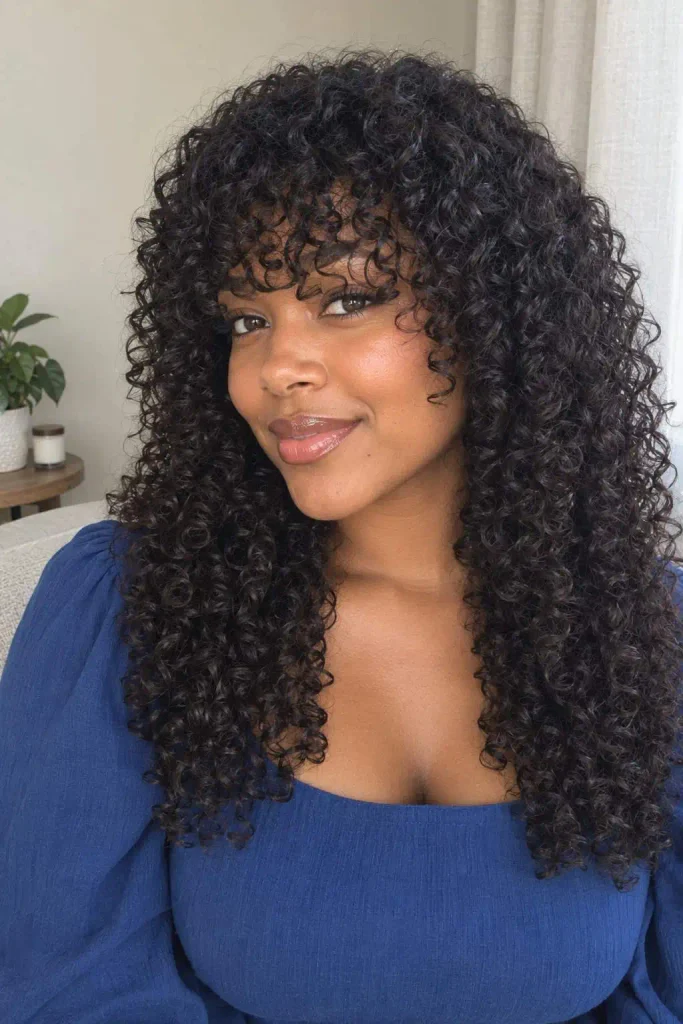
Light curly bangs for fine hair
A narrow front section forms airy, separated curls, so the fringe adds shape without taking too much density from the sides. Slightly longer temple pieces blend into the haircut. Light curly bangs for fine hair keep their bounce with a foam rather than a cream, and light golden blonde color makes the thin curls look fuller.